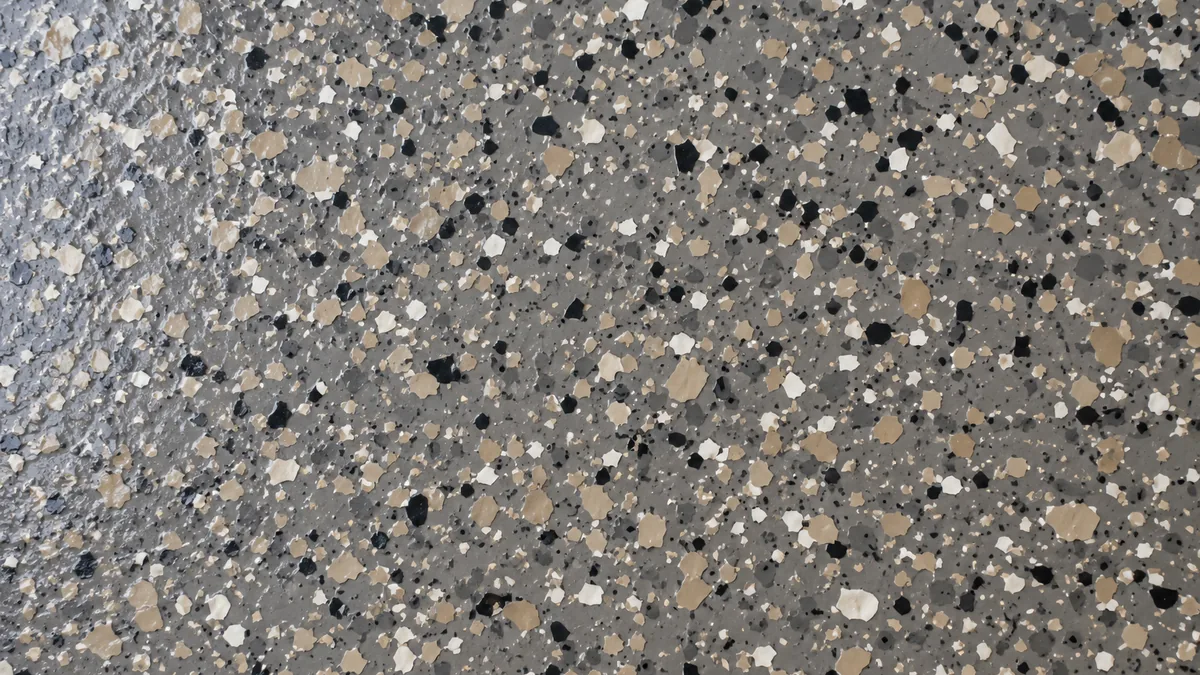
Vinyl flake, sometimes called chip or fleck, is a coloured plastic chip broadcast into a wet base coat and then sealed under a clear topcoat. It is the standard finish on residential floors in this city, and it earns that position on practical grounds before aesthetic ones.
What flake actually does
It hides dirt. A multi-tone speckled surface breaks up the eye. Pine needles walked in from a Hoover yard, red clay off boots in March, dust, tyre marks and the odd oil drip all disappear into the pattern. A solid colour shows every one of them.
It adds grip. Flake edges create texture in the surface itself, before any aggregate is added to the topcoat. On a floor that gets wet from a car coming in during a thunderstorm, that matters.
It adds thickness. A full broadcast builds the system considerably, and total film thickness is one of the things that determines how a floor takes impact and abrasion.
It hides slab imperfection. Repaired cracks, patched spalls and the general unevenness of an older slab read far less obviously under a broadcast flake than under a flat colour.
Full versus partial broadcast
The single decision that changes the look most, and it is worth understanding before you look at colour samples.
Full broadcast, also called broadcast to refusal. Flake is thrown until the surface will not take any more and the base coat is completely hidden. The result is a heavily textured, granite-like floor with no base colour showing. Maximum concealment, maximum texture, maximum thickness. Excess is scraped and vacuumed before topcoating, and the scrape is what determines how smooth the finished surface feels.
Partial broadcast. Flake is scattered at a controlled density, leaving base colour visible between the chips. Lighter, more contemporary, and considerably less forgiving of what is underneath. It also uses less material, which is why it is sometimes cheaper.
Most garages get full broadcast. Partial suits floors that are being looked at rather than used hard, and it suits basements more often than garages.
Flake size
Chips come in different sizes, typically from around a quarter inch up to an inch. Larger flake reads as bolder and more dramatic and creates more surface texture. Smaller flake reads as finer and closer to a stone finish.
On a big three-car garage, larger flake tends to look right because the floor has the area to carry it. In a small utility room the same chip can look busy.
Choosing a blend for Birmingham
Some practical guidance rather than a colour chart.
Warm greys and tans with black and white flecks are the workhorse and the safest choice. They hide red clay, which is the specific local contaminant that shows on cooler blends.
Blends with a tan or beige component handle Alabama soil better than cool grey blends do. This is a genuinely local consideration and it is the thing we most often steer people on.
Very light blends brighten a dark garage and make a basement feel larger, and they show less dust than people expect because dust is usually light coloured. What they do show is oil.
Very dark blends look striking and show every speck of dust and pollen. They also run hot if any part of the floor sees direct sun.
Team colours come up here more than in most places. Crimson and white, or orange and blue, are both readily available as flake blends. They look better in a small area, such as a strip or a border, than across an entire floor.
Look at samples in daylight and at the size you will actually see them. A two-inch sample chip tells you very little about a four hundred square foot floor.
The scrape, and why it matters
After a full broadcast, loose flake is scraped back and vacuumed before the topcoat goes on. How aggressively that is done sets the final texture.
A light scrape leaves a more pronounced, grippier surface. A heavier scrape gives a smoother, more uniform feel that is easier to sweep and mop.
It is worth saying which you want. A floor that will be swept regularly benefits from a smoother scrape; a floor that gets wet benefits from a rougher one. This is one of the details that separates crews who do this often from crews who do not.
Maintenance
Sweep or blow it out, mop with a neutral cleaner, and avoid anything acidic on the topcoat. Rubber-backed mats can leave marks on a coating that has not fully cured, so keep those off for a couple of weeks.
The topcoat is the wearing surface, and after many years it can be abraded and recoated without touching the flake underneath. That is a modest job compared with the original and it resets the floor.
Where flake is not the answer
In a commercial kitchen, where a smooth cleanable surface with specified slip resistance is required. In a warehouse, where a plain high-build system is cheaper across a large area and appearance is not driving the decision. And where a client specifically wants a poured, seamless, marbled look, which is metallic epoxy rather than flake.
For the full installation process, see garage floor coating. For a similar textured finish using a different medium, see quartz broadcast flooring.
Common questions
Is flake slippery when wet?
Less than a smooth coating, because the chips create texture. Where grip really matters, aggregate goes into the topcoat as well.
Can I match a specific colour?
Within the available blends and base pigments, usually close. Bring whatever you are matching to and we will show you the nearest options in daylight.
Does the flake come loose?
Not once it is sealed under the topcoat. Loose material is scraped and vacuumed off before topcoating, which is exactly what that step is for.
Full or partial broadcast for a garage?
Full, in most cases. It hides more, grips better and builds thickness. Partial suits floors that are being looked at more than used.
Which blend hides red clay best?
Anything with a tan or beige component. Cool grey blends show Alabama soil noticeably more, and that is the single most useful local piece of advice on this page.
Can the floor be refreshed later?
Yes. The topcoat is the wearing layer and can be abraded and recoated years later without disturbing the flake beneath.
Get a free quote
Tell us the space and roughly how big it is. We'll come measure it, and you get the scope and the price in writing.