Epoxy Flooring Birmingham covers Mountain Brook for garage floor coatings, basement floors, terrace and patio work, pool decks and driveways. What follows is about the concrete here specifically, because it is genuinely unlike the rest of the metro.
Old houses, old slabs, detached garages
Mountain Brook was laid out in the 1920s around the villages at Crestline, English Village and Mountain Brook Village, and a great deal of the housing dates from that era through to the 1950s.
That produces something we see almost nowhere else in volume: the detached garage. Often a separate structure at the end of a drive, sometimes a converted carriage house, occasionally with a room above it.
Detached garages bring their own conditions. They are unheated and unconditioned, so temperature and humidity swing further than an attached garage does. They frequently sit lower than the house on a sloped lot. And their slabs are often the original pour, which means concrete that is eighty or ninety years old.
Ninety-year-old concrete is not automatically a problem. Pre-war concrete in this area is frequently dense and well made. What it does have is history: oil that has soaked in over generations, surface wear, patches from various decades, and often more than one previous coating or paint.
What we look for on older estate concrete
Multiple layers. A garage floor that has been painted or sealed several times over ninety years can have a build-up that takes real effort to remove. We grind a test patch to find out what is down there before quoting rather than after starting.
Deep oil contamination. Decades of cars that leaked. Oil that has wicked deep into porous concrete can interfere with adhesion, and the worst areas occasionally need cutting out.
Slab thickness and edges. Older slabs were sometimes poured thin at the edges, and the apron where the garage door sits is frequently the most damaged part.
Movement. A detached structure on a sloped lot has had ninety years to settle. Cracks with displacement between the two sides are a different conversation from shrinkage cracks, and we will say which yours are.
Basements in period houses
Mountain Brook basements are frequently the original, poured long before vapour barriers existed as a standard practice, in houses built into slopes above Shades Creek and along the ridges.
This is the strongest case for moisture testing anywhere in the metro. A calcium chloride test or relative humidity probes cost very little against the price of coating a slab that will push the floor off within two years.
Where readings come back high, the answer is usually a moisture-mitigating primer. Sometimes it is drainage work outside first, and we would rather tell you that and lose the job than coat over it.
Finishes that suit a period house
A consideration that barely arises elsewhere. A bright modern flake floor can look wrong in a 1926 detached garage or a period basement, and several clients here have wanted something quieter.
Acid staining works well on old concrete. It colours the slab itself and keeps its variation and history, and there is nothing on the surface to peel. On a floor with genuine character, this is often the more sympathetic answer. See concrete staining.
Polished concrete reveals what the slab contains, and old concrete frequently contains interesting aggregate. It is also the most durable option, because nothing sits on top to fail. See concrete polishing.
Muted flake blends in soft greys and tans give the practical benefits of a coating without the showroom look.
Where the garage is genuinely a working garage, the standard flake system remains the right answer and there is no reason to overthink it.
Terraces, steps and pool surrounds
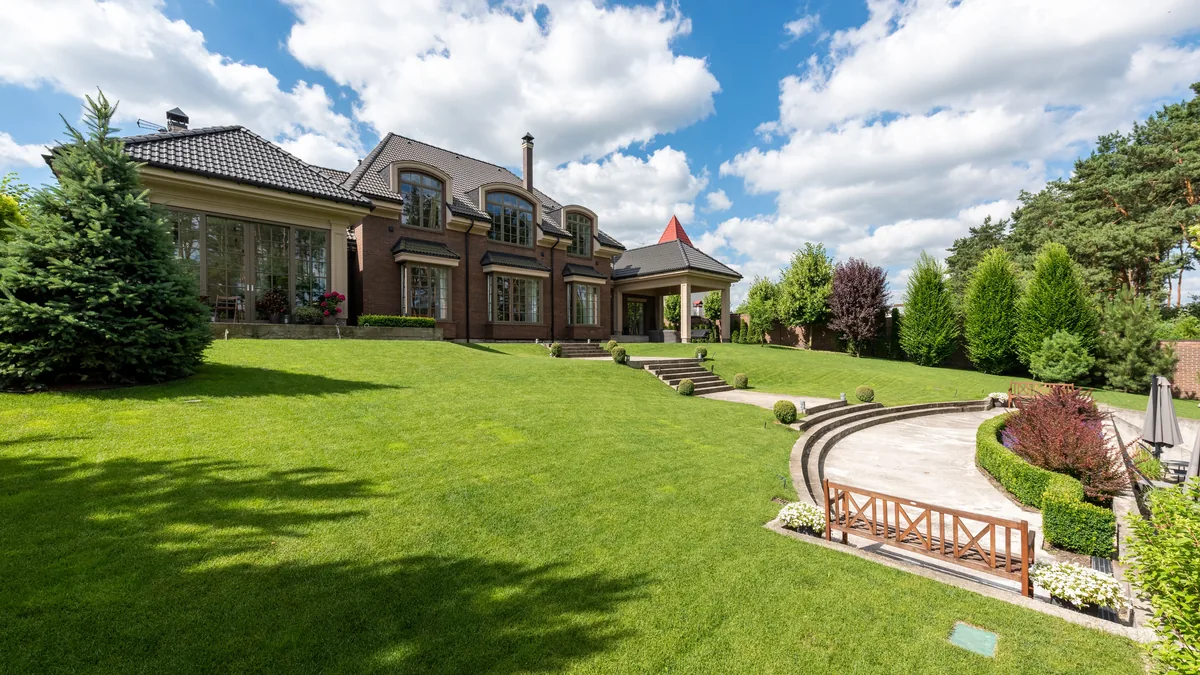
Mountain Brook gardens are terraced, because the land is. That means retaining walls, flights of steps between levels, and hard surfaces on cut platforms.
Steps are where grip matters most, and shaded steps under mature trees stay damp through the winter and grow algae. Aggregate grade goes coarser there than anywhere else on the property.
The tree cover is worth mentioning in its own right. Mature oaks and hardwoods across Mountain Brook drop leaf litter and tannins onto hard surfaces for months, and tannin stains bare concrete stubbornly. A sealed surface washes; open concrete does not.
Access and working around the property
Some Mountain Brook drives are long, narrow, steep or all three, and a detached garage at the end of one can be awkward to get equipment to. We will ask about access when booking.
Grinding is dusty and noisy. On properties where that matters, and in houses where the garage is close to a neighbour, it is worth planning the day rather than assuming.
What we will tell you
On a ninety-year-old slab, sometimes the honest answer is that the concrete has reached the end of its life and a coating is money spent on a surface that is failing underneath. That is not common, but it happens, and you should hear it on the first visit.
More often the answer is that the concrete is fine and it is the ninety years of coatings on top of it that need dealing with. That is a bigger preparation job than a modern garage and it should be priced as one.
For the full garage process, see garage floor coating. For period basements, basement floor coating.
Common questions from Mountain Brook
Our garage floor is from the 1920s. Is it too old to coat?
Usually not. Pre-war concrete here is often dense and well made. The work is in removing decades of paint and dealing with soaked-in oil, not in the age itself.
Our detached garage floor has been painted several times. What is involved?
Grinding it all off. We cut a test patch first to find out how many layers are down there, because that decides the price.
Do we need a moisture test on our basement?
In a period house built into a slope, we would want one. Those slabs predate vapour barriers, and vapour drive is what lifts basement coatings from underneath.
Is there a finish that suits an older house?
Acid staining and polished concrete both keep the character of the slab rather than covering it. Muted flake blends are a middle option.
Will the crack across our garage floor show?
Depends whether it is moving. A shrinkage crack can be repaired and disappears under a full broadcast. A crack with one side higher than the other is settlement, and it will come back.
Our drive is narrow and steep. Is that a problem?
Worth mentioning when you call so we bring the right equipment. It is common here and it is manageable, but not something to discover on the morning.
Get a free quote
Tell us the space and roughly how big it is. We'll come measure it, and you get the scope and the price in writing.