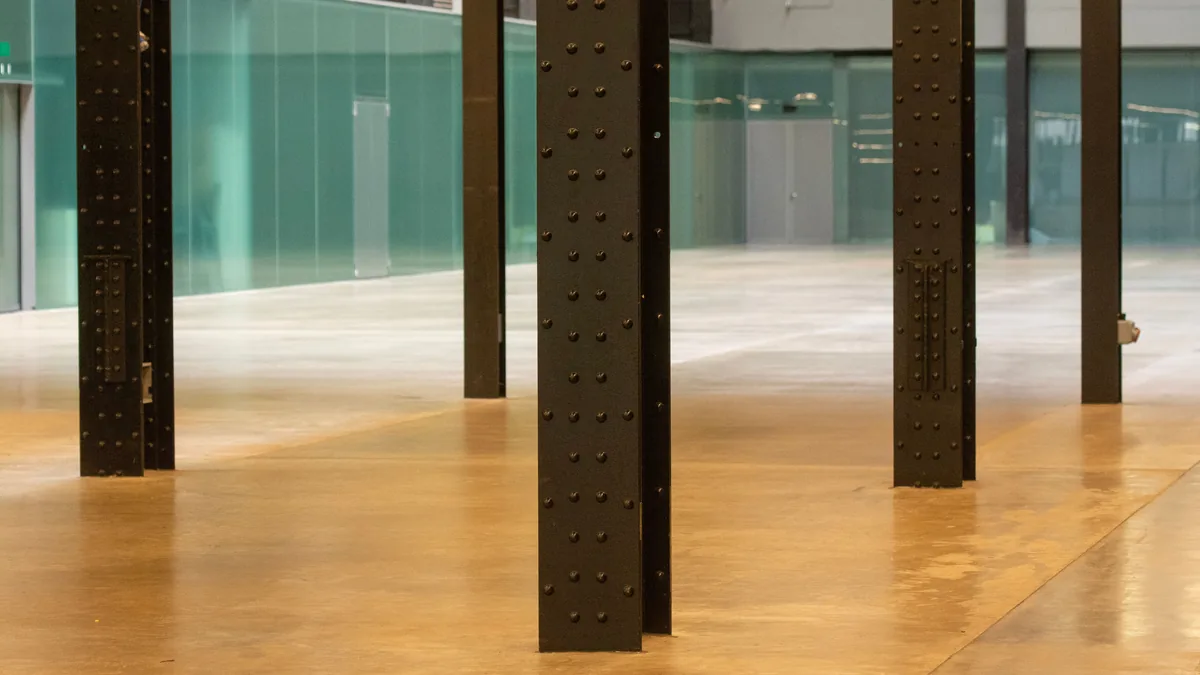
A metallic floor has depth. Rather than a flat colour or a speckled texture, you get movement, translucency and a marbled effect that reads more like poured stone than like a coating. In the right room it looks superb.
It is also the finish we most often talk people out of, and not because we cannot install it.
How the effect is made
Metallic pigments are extremely fine mica-based particles suspended in a clear or tinted epoxy. Once mixed and poured, the pigment migrates within the wet resin, and that migration is what creates the movement.
The installer influences it, deliberately, using rollers, brushes, solvent misting and sometimes a heat gun or air to open cells and create the veining. Multiple colours poured together and worked into each other produce the marbling.
Then a clear topcoat goes over the top to protect it and provide the wear surface.
The important consequence: no two floors are the same and no floor can be exactly reproduced. You are commissioning a finish, not selecting one. Photographs show you a style, not a result.
Where it belongs
Showrooms and retail. Reflectivity and depth do real work in a space where the floor is part of how the business presents itself.
Basements finished as living space. Common in older Birmingham houses where a lower level becomes a den or a bar. Metallic in a room with good lighting is dramatic and there is no UV to worry about.
Garages being used as display space. Where the car is a collection rather than transport.
Restaurants and bars, front of house.
Where it does not
Outdoors, in any form. Epoxy is aromatic and ambers under UV, and the metallic effect degrades. Even under a UV-stable topcoat, the pigment layer beneath is exposed to light through it. Do not put this on a patio.
A working garage. This is the one that catches people. A metallic floor is smooth and glossy, which means it shows every speck of dust, every tyre mark and every drip. It also shows scratches in a way a flake floor does not, because there is no texture to break up the reflection. A garage where a lawnmower gets dragged across the floor is not a good home for one.
Anywhere with slip risk. A polished metallic surface is slippery wet. Aggregate can be added to the topcoat, but it dulls the effect, which rather defeats the purpose.
Commercial kitchens and industrial floors. Wrong chemistry entirely.
What it costs and why
Substantially more than a flake floor of the same size. Three reasons.
Materials are more expensive: metallic pigments cost more than vinyl chip, and the system uses more resin because it is poured rather than rolled.
Labour is longer and more skilled. Creating the effect is hands-on work by somebody who has done it enough to control the outcome, and it cannot be rushed.
Preparation has to be better. A flake floor forgives minor substrate imperfection because texture conceals it. A glossy metallic floor conceals nothing: every low spot, trowel mark and patch reads through the reflection. Getting a slab flat enough for a metallic floor sometimes means skim coating first.
The honest limitations
It shows everything. Dust, footprints, water spots. In a showroom that gets mopped daily, fine. In a garage, tiring.
It scratches visibly. The topcoat takes the damage rather than the metallic layer, so it can be refreshed, but scratches show on a gloss surface long before they would on flake.
You cannot preview it. Sample boards show the palette and the general character. The floor you get will be its own thing. People who need certainty about appearance are usually happier with flake.
Repairs are difficult to blend. A patch in a flake floor can be made close to invisible. A patch in a metallic floor is visible, because the pattern cannot be matched.
Colour and lighting
Metallic depends on light. In a dark basement with a single ceiling fixture, a dramatic floor looks like a dark floor. The effect needs light to reveal it, and lighting design is worth thinking about alongside the floor rather than after it.
Darker palettes read as more dramatic and hide less. Lighter palettes are more forgiving day to day and brighten the room.
Substrate flatness, which is the hidden cost
This is the part that catches people out on price, so it is worth explaining properly.
A flake floor is textured and variegated. Minor undulation in the slab, an old patch, a slight hollow where something stood for years: none of it reads through, because there is nothing uniform for the eye to measure against.
A metallic floor is glossy and reflective. Reflection is a measuring instrument. Every low spot shows as a distortion in the reflected light, every trowel ridge catches, and every patch reads as a different depth. The floor becomes a mirror of its own imperfections.
Which means the preparation standard is higher, sometimes considerably. On a slab that is not flat enough, the honest answer involves a self-levelling or skim coat before the metallic goes down, and that is a real cost that has to be in the quote.
If somebody has quoted you a metallic floor at close to flake prices, ask what they are doing about substrate flatness. The answer is often nothing, and you find out on the day the lights go on.
Our usual advice
If the floor is being looked at, metallic is worth the money. If the floor is being used, flake is the better decision and you will be happier with it in two years.
A middle option that works well: metallic in a finished basement or a display bay, flake in the working part of the same building. There is no rule that says one floor throughout.
For the alternative most people end up choosing, see flake flooring. For a commercial space where reflectivity matters, retail and showroom flooring.
Common questions
Can I get exactly the floor in the photo?
No, and nobody can. The effect forms as the pigment migrates and it cannot be reproduced. You choose a palette and a style; the floor is its own.
Can it go on a patio?
No. Epoxy ambers under UV and the effect degrades. Outdoor concrete needs an aliphatic system, and metallic is not that.
Is it slippery?
Yes when wet, because it is smooth and glossy. Aggregate in the topcoat helps and dulls the effect, which is a real trade-off.
Will it scratch?
The topcoat will, and scratches show more than on a textured floor. The topcoat can be abraded and recoated later without disturbing the metallic layer.
Is it good for a working garage?
Usually not. It shows dust, tyre marks and scratches with nothing to hide them. A display garage is different from a working one.
Why does it cost so much more than flake?
More expensive material, more skilled labour, and much higher preparation standards because gloss conceals nothing about the substrate underneath.
Get a free quote
Tell us the space and roughly how big it is. We'll come measure it, and you get the scope and the price in writing.