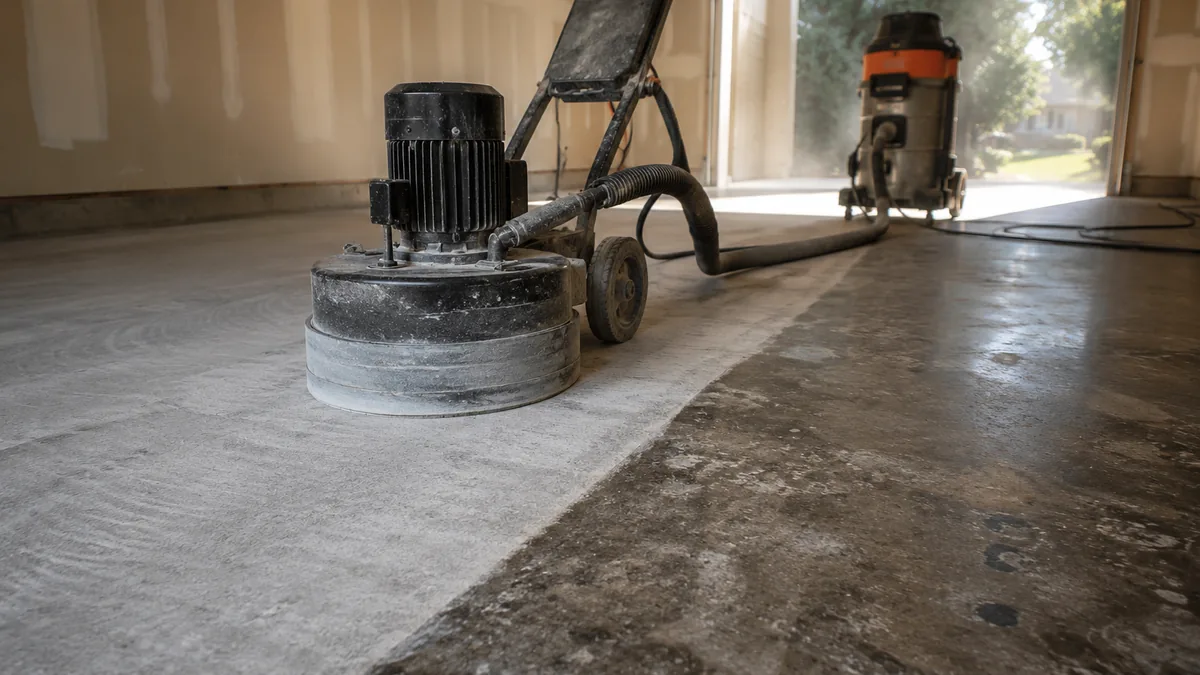
A bare concrete garage slab in Birmingham has three problems. It powders, so there is always a fine grey dust on everything at the bottom of the shelves. It is porous, so oil, brake fluid and battery acid soak in and stay. And it is grey, cracked and stained, which is why most people finally call.
A coated floor solves all three at once. But the reason we lead with preparation rather than colours is that a coating is only ever as good as its bond to the slab, and in this city we spend a lot of time removing other people's failed work.
Why coatings fail in Birmingham specifically
Hot tyre pickup. This is the local killer and it deserves the top spot. A tyre that has been on I-459 for half an hour comes home genuinely hot. Park it on a rigid coating and the warm rubber bonds to the surface; when you reverse out the next morning, the coating comes with it in patches shaped like your tyres. Traditional epoxy is especially prone to this because it cures hard and inflexible. Polyurea flexes, and that is most of the reason it replaced epoxy on residential garages.
No mechanical preparation. A slab that has been acid-etched rather than ground has an inconsistent profile, and the coating grips in some places and not others. It looks identical on day one. It separates in sheets somewhere in year two. Diamond grinding is not an upsell, it is the job.
Moisture from underneath. Plenty of Birmingham garages are on slabs poured before vapour barriers were routine, and some sit into a slope where groundwater is a factor. Vapour moving up through concrete will push a coating off no matter what it cost. Where the slab warrants it, that gets tested rather than guessed at.
Coating over a failure instead of removing it. New product on top of a delaminating old one buys you about a season.
What we actually do
1. Look at the slab
We measure, check for cracks, spalling and pitting, look at the transition at the garage door where water gets in, and check for previous coatings. If there is any reason to suspect vapour drive, that is where a calcium chloride test or relative humidity probes come in. This visit is free and it is the only way to give you a number that will not move.
2. Diamond grinding
The whole floor gets ground with a planetary grinder running diamond tooling, taking the surface back to open concrete with a consistent profile. Edges and corners are done by hand. This is dusty work and it is done with vacuum extraction, but it is also the step that decides whether you are still happy with this floor in ten years.
3. Repairs
Cracks get chased out into a V and filled with a rigid polyurea or epoxy filler that is harder than the surrounding slab. Spalled areas and pitting get rebuilt. Control joints are treated according to whether they are still moving. A coating cannot bridge a crack that is alive underneath it, so the honest answer on some slabs is that the joint will remain visible.
4. Base coat
A pigmented polyurea base goes down. It penetrates into the ground profile and it is flexible enough to move with the slab through Birmingham's temperature range, which matters more than people expect in an uninsulated garage that swings from near freezing in January to well over 40°C in an August afternoon.
5. Flake broadcast
Vinyl flake is broadcast into the wet base coat. Full broadcast, meaning to refusal, gives a heavily textured floor that hides absolutely everything. Partial broadcast gives a lighter, more scattered look with more of the base colour showing. This is the step where you actually choose how the floor looks, and it is worth seeing samples in daylight rather than on a screen.
6. Scrape, vacuum and topcoat
Loose flake gets scraped back and vacuumed, then a UV-stable polyaspartic topcoat goes over everything. The topcoat is what gives you the chemical resistance, the cleanability and the finish. If any part of the floor sees daylight through a window or an open door, UV stability is what stops it going yellow.
Timing and what it means for you
Most two-car garages are a single day from first grind to final topcoat. You can generally walk on it that evening. Vehicles should stay off for around 24 hours, and heavier items and rubber-backed mats a little longer while the coating reaches full chemical cure.
You will need to empty the garage before we arrive. Everything, including the shelving if it is not fixed to the wall. This is the part homeowners underestimate, and it is worth starting the weekend before.
Finishes
Flake blends are the standard, and they are popular for a practical reason as much as an aesthetic one: texture hides dirt, tyre marks and the odd dropped tool. Solid colours look sharper and show everything. Metallic systems create a poured, marbled depth and belong in a garage that is being used as a showroom rather than for storing a lawnmower.
Grip is adjustable. Aggregate can be added to the topcoat for more slip resistance, which matters if the floor gets wet from a car coming in during a downpour, and matters a lot on any slope.
What it costs
A standard two-car garage on a sound slab lands in the low thousands. Three variables move the number: total square footage, how much repair the concrete needs, and whether an existing coating has to be removed first. That last one is the big one. Grinding off a failed epoxy floor can cost more than laying the new system.
Anybody quoting a firm price over the phone is guessing at the condition of your concrete, and the condition of your concrete is the thing that matters most. We would rather come and look.
Is your garage a good candidate?
Most are. The ones that need a conversation first are slabs with active moisture, slabs with structural cracking rather than surface cracking, and slabs that have been sealed with something that has to come off completely. None of those are automatically disqualifying, they just change the scope, and you should hear about them before you commit rather than after.
If you are choosing between systems, our page on polyaspartic coatings explains what goes on top and why. If your existing floor is peeling, start at repair and recoating instead.
Common questions
How long before I can park on it?
About 24 hours for vehicles. You can usually walk on it the same evening. Full chemical cure takes a few days, which mainly affects when you should put rubber-backed mats down.
Do I have to empty the garage?
Yes, completely. The whole slab gets ground, so nothing can be left standing on it, including shelving that is not wall-mounted.
Will it hide the cracks?
Repaired cracks disappear under a full flake broadcast in most cases. A joint that is still moving will telegraph through eventually, and we will tell you which ones those are before we start rather than after.
Is polyaspartic worth the extra over epoxy?
In a garage in Alabama, yes, and mostly because of hot tyre pickup and UV. Epoxy still has its place on interior industrial floors that never see sunlight or warm tyres.
Can you match a colour?
Within the range of available flake blends and base pigments, largely yes. Bring a sample of whatever you are matching to and we will show you what is close.
What about the strip at the garage door?
That edge takes water, UV and the most temperature movement, so it is the first place a bad job shows. It gets ground and coated like the rest, and where the slab edge is damaged it gets rebuilt first.
Get a free quote
Tell us the space and roughly how big it is. We'll come measure it, and you get the scope and the price in writing.