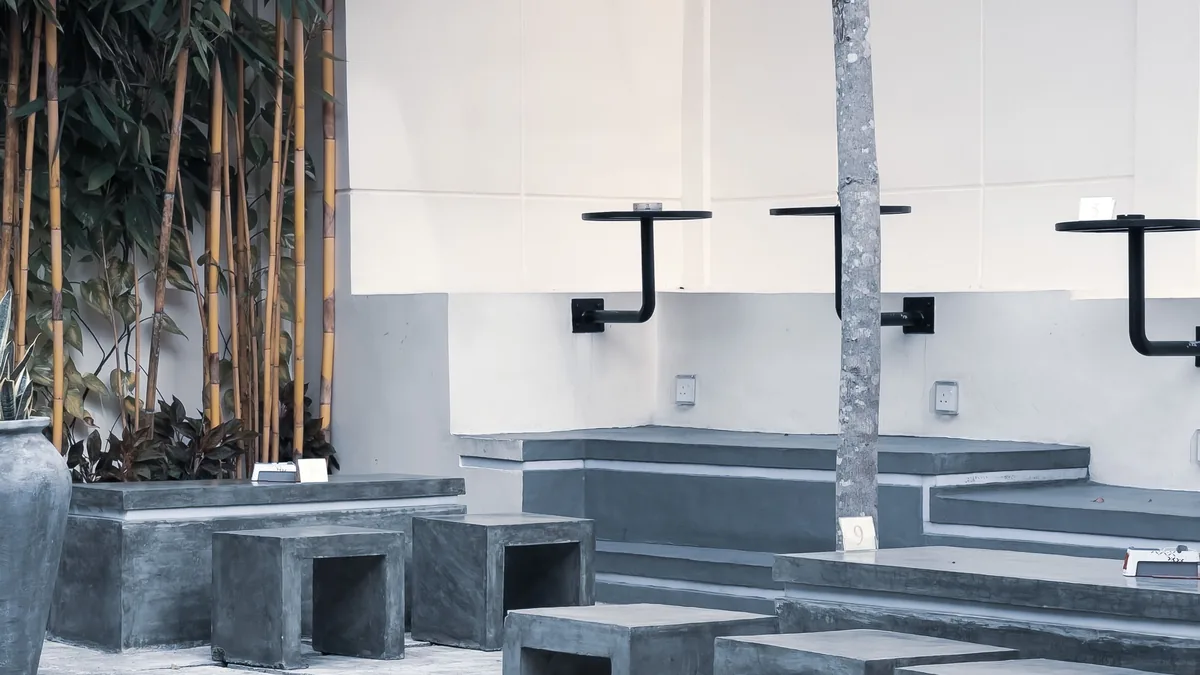
Front walks, side paths, the run from the driveway to the door, steps between levels on a sloped Birmingham lot, and the connecting paths around a pool or patio.
These get treated as an afterthought and they are the surface where a coating decision has the clearest safety consequence.
Grip comes first
A walkway is used at night, in rain, by people carrying shopping, and by visitors who do not know where the awkward step is. On a sloped lot, which describes a great deal of Birmingham, it is also frequently on a gradient.
Aggregate in the topcoat is not optional on a path. The grade goes coarser than we would use on a covered porch and coarser than a patio in most cases. On steps and on any slope steeper than gentle, coarser again.
The trade-off is that coarse texture is harder to sweep and traps leaf debris. On a path that is an acceptable trade and on a patio it might not be.
Trip hazards, and when coating is the wrong answer
The most common problem with an older Birmingham walkway is not appearance. It is that one slab has lifted relative to the next, usually from a tree root or from settlement, and there is now a lip.
A coating does not fix a lip. It coats the lip. If anything it makes it less visible, because a uniform colour across two slabs removes the visual cue that there is a step there.
Where displacement exists, the honest options are grinding the lip down where it is small enough, slab jacking to lift the low side, or replacing the section. Any of those before a coating, not instead of noticing it.
We will point these out on the survey. It is the single most useful thing we do on a walkway job.
Steps
Concrete steps get their own attention because they are where falls actually happen.
Nosings take the most wear and are usually the most damaged part of any step run. Where the nosing has broken away, it gets rebuilt before coating, and a coating over a crumbling nosing simply hides how thin it has become.
Grip on a tread matters more than anywhere else on the property. Some installations get a coarser aggregate strip at the front of each tread and a finer finish behind, which gives traction where the foot lands without making the whole step feel like sandpaper.
Contrast helps too. A slightly different tone on the nosing makes the edge visible in poor light, which is a genuine safety improvement and costs nothing extra.
Width, edges and termination
A path is mostly edge. On a four-foot walkway, a much higher proportion of the total area is within a few inches of a free edge than on a driveway or a patio.
Edges are where water gets under a coating, where mower damage happens, and where the coating either terminates cleanly or starts lifting. Preparation right to the edge, and a clean termination, matter disproportionately.
Where a path meets grass or planting, soil and moisture sit against the edge constantly. Where it meets a driveway or patio, the junction wants a deliberate detail rather than a fade.
UV and colour
Same rules as any outdoor concrete. Aliphatic topcoat, or it ambers within a season. See patio coating for the fuller explanation.
Colour choice on a path has a practical dimension: a lighter walkway is considerably easier to see at night, and a path is used after dark far more than a patio is. Where there is no lighting, that is worth more than the aesthetic argument for a darker tone.
Drainage and the things beside the path
Two local considerations worth checking before you spend money.
Downspouts discharging onto or across a walkway keep it wet, grow algae on it, and undermine it over time. Extending the discharge is cheap and it makes the path last longer whether or not it gets coated.
Tree roots are the other one. Birmingham has a lot of mature oaks and their roots lift walkways reliably. If a root has already displaced a slab, coating over it buys you a year or two before the same movement continues.
When a path is worth coating
Sound concrete, level between slabs, that has gone grey, stained or algae-marked and needs grip and appearance restored. That is a good candidate and a straightforward job.
Where the path is spalled across most of its length, or where slabs have moved, the money is usually better spent on repair or replacement first.
And where the complaint is simply that it gets slippery with algae in shade, sometimes the answer is a penetrating sealer and better drainage rather than a full coating system. We will say so.
For the driveway it connects to, see driveway coating. For a covered entrance, porch coating.
Common questions
My path has a raised lip between two slabs. Can you coat over it?
We can, and we would rather not. A coating makes a lip less visible without making it less of a hazard. Grind it, jack it or replace the section first.
How rough will it feel?
Rougher than a patio and deliberately so. On a path used at night in the rain, grip beats comfort.
Can you do the steps to match?
Yes, with rebuilt nosings where needed and usually a coarser aggregate on the tread front. A contrasting nosing tone is worth considering for visibility.
It goes green in the shade every winter. Will coating stop that?
It helps, because algae grips sealed surfaces less well and washing is easier. It does not fix a path that stays permanently wet, which is a drainage problem.
Tree roots have lifted part of it. Worth doing?
Not until the movement is addressed. The root is still growing and the same displacement continues under a new finish.
Is a sealer enough?
Sometimes, particularly if the issue is algae and staining rather than appearance or grip. It costs a fraction and cannot peel.
Get a free quote
Tell us the space and roughly how big it is. We'll come measure it, and you get the scope and the price in writing.